
Compare roofing underlayment options for homes in Illinois and Wisconsin: felt, synthetic, and ice and water shield, plus code rules and which to choose.
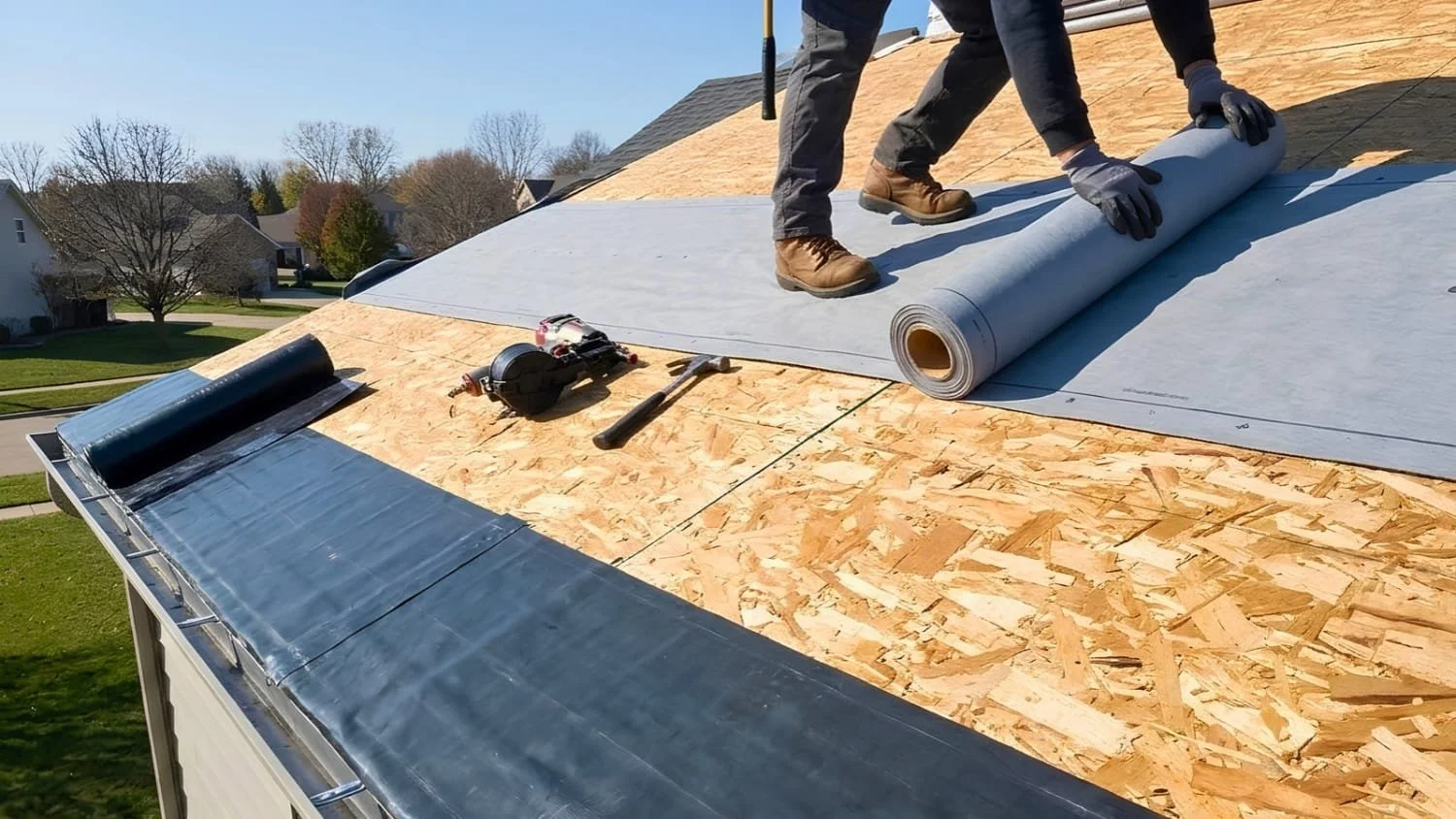
The best roofing underlayment options for most homes in Illinois and Wisconsin are synthetic underlayment on the open field of the roof deck, paired with self-adhered ice and water shield at the eaves, valleys, and penetrations.
Wisconsin's Uniform Dwelling Code sets a statewide minimum for underlayment and ice dam protection, while Illinois leaves most residential roofing rules to cities, villages, and counties, many of which have adopted the International Residential Code (IRC). Avondale Roofing walks homeowners through these options every day, and the right combination comes down to your roof's slope, your attic's ventilation, and how much ice-dam history your house has.
On a shingle roof in Madison or Elgin, choosing underlayment means making two decisions. One is what covers the open field of the roof deck. The other is what goes at the eaves, in the valleys, and around chimneys and vents.
Roofing underlayment in Illinois and Wisconsin has to stand up to ice dams, sideways rain, and months of freeze-thaw cycles. For most homes, Avondale Roofing's default is synthetic underlayment on the field and self-adhered ice and water shield at the edges and seams. Felt still has a place, but a smaller one than it used to.
What Does Roofing Underlayment Actually Do?
Underlayment is the water barrier between your roof deck (the plywood or OSB boards) and your shingles or metal panels. Shingles shed most of the water that hits your roof. Underlayment catches what slips past them.
Midwest winters give it plenty to catch. Snow melts on the warm upper roof, runs down, and refreezes at the cold eave. That ridge of ice is an ice dam, and it pushes meltwater back up under the shingles. Spring and summer storms drive rain sideways under the shingle tabs. Freeze-thaw cycles keep working on every gap and nail hole until the snow finally clears. If ice dams already show up on your house, getting ice dams under control matters just as much as the layer under your shingles. Avondale's breakdown of how snow and ice damage your roof covers the mechanics in more depth.
Install day is the other test. Crews walk on underlayment, and it may sit exposed for a stretch if a storm rolls in mid-job. A sheet that tears or wrinkles in that window leaves a weak spot nobody sees again for years.
How Do Roofing Codes in Illinois and Wisconsin Differ?
Wisconsin applies one statewide code to houses; Illinois leaves the rules to individual towns and counties. That matters if you live near the state line in Beloit, South Beloit, or Rockford, where a neighbor across the border may be working under different requirements.
What Does Wisconsin's Code Require?
Wisconsin uses one statewide code for one- and two-family homes: the Uniform Dwelling Code. According to Wisconsin's Uniform Dwelling Code (SPS 321.28), shingle roofs need underlayment of No. 15 asphalt-impregnated felt paper, or an equivalent material that shows no water transmission under ASTM D 226 or ASTM D 4869 (synthetic and self-adhered products that meet ASTM D 1970 satisfy this). That's the bare minimum; both 30 lb felt and synthetic underlayment exceed it.
SPS 321.28 also spells out ice dam protection: on shingled or shake roofs over a heated living area or attached garage with a slope of 4:12 or less, you need ice dam protection made of sheet metal or an ASTM D 1970 product. It must extend at least 30 inches up the roof slope from the roof edge, and at least 12 inches up the slope past the inner face of the exterior wall.
The code also requires corrosion-resistant flashing at chimneys, valleys, and roof openings, and it restricts installing new roofing over old coverings that are water-soaked, deteriorated, or already doubled up.
You can read the full text through the Wisconsin Legislature or Cornell's Legal Information Institute. Read the current version itself rather than a summary, since wording changes and quoted snippets go stale.
In practice, a home in Milwaukee starts from the same statewide baseline as homes elsewhere in Wisconsin.
How Do Illinois Rules Work Town by Town?
Illinois has historically left residential building codes to local governments. Since January 1, 2025, state law has required any local code to meet a minimum structural design standard, but cities, villages, and counties still adopt their own rules, and many base theirs on an edition of the IRC.
Chicago writes its own building code, so requirements in Elgin, Schaumburg, and a rural township can all look different.
Where a town has adopted the IRC, two provisions matter most for underlayment:
Ice barrier: According to the International Residential Code (R905.1.2), in areas with a history of ice forming at the eaves and backing up water, an ice barrier (two cemented layers of underlayment or a self-adhering polymer-modified bitumen sheet) must run from the eave edge to a point at least 24 inches inside the exterior wall line. Most of Northern Illinois fits that description.
Low slopes: On asphalt shingle roofs pitched from 2:12 up to 4:12, the IRC calls for two layers of underlayment, or an approved alternative, because water drains slowly on a shallow roof.
Either way, check with your local building department before work starts, or hire a contractor who pulls the permit and knows that office. The inspector's reading is the one that counts, and code editions vary by town.
Which Roofing Underlayment Option Is Best: Felt, Synthetic, or Ice and Water Shield?
Synthetic underlayment paired with self-adhered ice and water shield at the vulnerable spots outperforms felt on nearly every measure that matters for Midwest roofs. Here are the three main options side by side. "30 lb felt" is the heavier of the two common felt grades; No. 15 felt is the lighter one.
| Factor | 30 lb felt | Synthetic | Ice and water shield |
|---|---|---|---|
| What it is | Asphalt-soaked paper or fiberglass mat | Woven or spun plastic sheet | Self-sticking rubberized asphalt membrane |
| Tear resistance | Low; tears under foot and in wind | High | High once bonded |
| When it gets wet | Wrinkles and buckles | Stays flat | Stays sealed to the deck |
| Seals around nails | No | No | Yes |
| Time it can sit uncovered | Short; cover it fast | Longer; check the maker's rating | Varies; check the maker's rating |
| Lets vapor through | Some | Most block it; breathable types exist | No |
| Relative cost | Lowest | Middle | Highest |
Why Does Ice and Water Shield Matter at the Eaves?
Ice and water shield seals around every nail as it goes in, which is exactly where ice dams do their damage. Felt and synthetic are both nailed down, and water backed up behind an ice dam can follow those nails through the deck no matter which of the two you choose. That's why codes target the eaves specifically.
Avondale Roofing also runs ice and water shield in every valley and around chimneys, skylights, and pipe vents, even where code doesn't require it, since those are the spots where water collects and moves slowly.
Why Does Felt Tear While Synthetic Stays Flat?
Felt is the weak link during the job. It tears when crews walk on it, and if rain hits it before shingles go down, it wrinkles. Those wrinkles can telegraph through new shingles as visible bumps.
Synthetic rolls are often lighter and cover more area per roll (compare specific products), and they hold up to foot traffic and wind while lying flat after a shower.
Ice and water shield grips hard once placed, so it can't shift after the backing comes off. In cold weather, the adhesive grabs less, which matters for late-fall jobs in Wisconsin.
Can Covering the Whole Roof Trap Moisture in the Attic?
More membrane isn't always better. Felt lets some water vapor pass through; most synthetics block it, and ice and water shield blocks it fully. Under a well-vented attic, that barely matters, since airflow dries the deck from below. Under a poorly vented attic or a cathedral ceiling, covering the entire deck in a vapor-blocking membrane can trap moisture in the wood.
If your attic feels damp or frosty in winter, fix the ventilation first instead of adding more ice and water shield.
How Much More Does Synthetic Cost Than Felt?
Felt costs the least per roll. Synthetic costs more per roll but covers more area and installs faster, so the gap in total project cost is usually small. Ice and water shield costs the most per square foot, which is why it's reserved for the spots where it does the most good.
Ask your contractor to list underlayment as its own line on a written estimate, so you can see exactly what you're paying for and compare it against the time it saves on install day.
For a longer list of what to ask before signing anything, see Avondale's questions to ask a roofing contractor before getting a quote.
What Underlayment Do Metal Roofs Need?
Metal roofs need heat-rated underlayment because metal panels get much hotter in summer sun than shingles do. Standard ice and water shield can soften under that heat, and some types stick to the back of the panels. Under metal, use membranes rated for high temperatures. Standing seam panels also expand and contract with the seasons, so many installers lay a slip sheet that lets panels move instead of grabbing.
Metal can collect condensation on its underside on cold nights, too, which makes solid underlayment more important here, not less. Avondale's look at metal roofing on Midwest homes covers cost and snow performance if you're weighing the switch, and the metal roof vs. asphalt shingles comparison digs into the broader trade-offs.
How Should You Match Underlayment to Your Roof's Slope and Attic?
Use this table as a starting point for your roof. Your local code and your attic's ventilation set the final details.
| Your situation | Field of the roof | Eaves, valleys, penetrations | Why |
|---|---|---|---|
| Standard shingle roof, vented attic | Synthetic | Ice and water shield | Tough on install day, sealed where ice dams form |
| Low slope (2:12 to 4:12) | Two layers, or full ice and water shield | Ice and water shield | Water drains slowly and finds nail holes |
| Heavy ice-dam history | Synthetic | Ice and water shield run well past the wall line | Covers the zone where meltwater backs up |
| Poorly vented attic | Synthetic or breathable type | Ice and water shield at code minimum | Avoids sealing moisture into the deck |
| Metal roof | High-temp synthetic or slip sheet | High-temp ice and water shield | Handles heat and panel movement |
| Small repair on an older roof | Match existing felt | Ice and water shield where possible | Ties in cleanly with what's there |
For a full replacement, Avondale Roofing picks synthetic over felt nearly every time. The price gap is small, and it removes most of the install-day risk. Felt still makes sense for small patches that tie into an older felt-lined roof.
If you're trying to decide whether your roof needs a patch or a full roof repair vs. replacement, that comparison walks through the signs worth weighing. And for homeowners further along in that research, Avondale's guide to popular roofing materials for Illinois homes and its breakdown of what is the best roofing material are good next stops.
Underlayment also works as a system with your shingles, and the asphalt shingles that last longest in Midwest weather perform best over a dry, flat base. If your home already has a track record of leaks after storms, Avondale's notes on preventing roof leaks during Wisconsin's stormy seasons are worth a read before you choose.
Frequently Asked Questions
What is the best underlayment to use on a roof?
For most shingle roofs in this region, synthetic underlayment on the field with ice and water shield at the eaves, valleys, and penetrations is the best mix among roofing underlayment options. Synthetic resists tearing and wrinkling, and the self-adhered membrane seals around nails where ice dams and slow-moving water do their damage. Metal roofs need high-temperature versions of both.
Does Wisconsin require ice and water shield?
Wisconsin's code requires ice dam protection, not necessarily the ice and water shield brand name, on shingled roofs over heated living areas or attached garages with a slope of 4:12 or less. According to SPS 321.28(4), that protection must be sheet metal or a product meeting ASTM D 1970, extending at least 30 inches up the slope from the roof edge and at least 12 inches past the inner face of the exterior wall.
Do Illinois homes need an ice barrier?
Only where the local town has adopted the IRC. In those jurisdictions, an ice barrier is required in areas with a history of ice forming at the eaves, extending at least 24 inches inside the exterior wall line. Since Illinois code adoption varies by city, village, and county, check with your local building department to confirm what applies to your address.
Can new roofing go over old roofing in Wisconsin?
Not always. Wisconsin's code restricts re-roofing over existing coverings that are water-soaked or deteriorated, over wood shake, slate, clay, cement, or asbestos-cement tile, or over a roof that already has two or more layers of roofing. A tear-off is usually the safer route once a roof has reached that point.
What is the 25 rule in roofing?
The "25 percent rule" is a code provision some places use: if a significant portion of a roof is repaired or replaced within a set period, the whole roof must be brought up to current code. It's best known from Florida's building code, where SB 4-D exempted roofs built to the 2007 Florida Building Code or later, though the rule still applies to older Florida roofs. It isn't a universal rule, so ask your local building department whether anything like it applies to your town before planning a partial reroof.
What thickness of roof sheathing does code require?
Code ties minimum sheathing thickness to how far apart your rafters or trusses are and to the span rating stamped on each panel. Wider spacing and heavier snow loads call for thicker panels. In practice, 7/16-inch OSB and 1/2-inch plywood are common on homes in this region, with thicker panels often used for wider spacing. Any soft or rotted boards should be replaced during a tear-off before new underlayment goes down.
Is 30 lb felt or synthetic better?
Synthetic is the better choice for most full replacements. Synthetics are generally lighter, tear-resistant, and often less slippery than felt (check the manufacturer's specs), and they stay flat when wet, while 30 lb felt is cheaper and lets more vapor pass through. Felt still fits small repairs that tie into an existing felt-lined roof.
How do I know what underlayment is on my roof?
You can't see underlayment from the ground, so the only way to know what's on your roof is to have someone look underneath the shingles or review your original installation paperwork. A roof inspection from a licensed contractor will identify what's there and whether it still meets current code.
Get a Clear Answer Before Winter Hits
Avondale Roofing has been a family-owned local business since 1988, serving homeowners and businesses throughout Wisconsin and Illinois, and holds GAF Master Elite and President's Club certifications. Every residential roof replacement Avondale quotes comes with a detailed written estimate that names the underlayment and ice barrier going on your home.
If you're in Janesville, Madison, Milwaukee, Beloit, Chicago, or anywhere else in Avondale's service area, schedule a free, no-obligation roof inspection. Avondale will check your deck, attic ventilation, and eave protection, and tell you plainly what your roof needs.